
 |
 |
 |
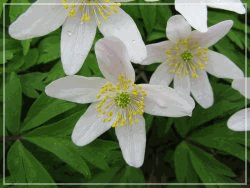
| Welcome Location Nature Events Books & Maps Links Site Map | SSSI CitationThe sessile oak high forest contains large areas of mature stand with trees above 30m high and up to 250 years old. Some areas support an understorey of previously coppiced hornbeam, with occasional standards of this species also present. Elsewhere both silver and downy birch Betula pendula and B. pubescens make up the canopy with pedunculate oak Quercus robur, ash Fraxinus excelsior, wild cherry Prunus avium and field maple Acer campestre scattered throughout the woodland. The shrub layer is dominated by honeysuckle Lonicera periclymenum and holly Ilex aquifolium with some rowan Sorbus aucuparia and sweet chestnut Castanea sativa, the latter under taller oaks. Typically for woodland of this type on acid soils the ground flora is sparse and dominated by bramble Rubus fruticosus and bracken Pteridium aquilinum. Towards the north chalk comes to the surface, reflected in woodland once dominated by wych elm Ulmus glabra and now being invaded by sycamore Acer pseudoplatanus. A diverse flora persists here comprising dog’s mercury Mercurialis perennis, yellow archangel Lamiastrum galeobdolon, wood anemone Anemone nemorosa and broad buckler-fern Dryopteris dilatata. Two uncommon helleborines are known from the wood, violet and broad-leaved helleborine Epipactis purpurata and E. helleborine. Moschatel Adoxa moschatellina, another local Hertfordshire species, is also present. In more acidic conditions a small mixed plantation supports a considerable amount of heather Calluna vulgaris. Additional habitats are provided by swallowholes fed by woodland streams and which hold seasonal water. A disused railway cutting bisects the wood and exposes calcareous soils. Colonisation by spindle Euonymus europaeus, dogwood Cornus sanguinea and guelder rose Viburnum opulus is underway. A typical woodland ride flora is developing forming an important habitat for invertebrates which does not occur elsewhere in the wood. |
© 2008-2023 |
e-mail: e-mail @ sherrardsparkwood.com |
Updated: 01/01/2023 17:37 |